
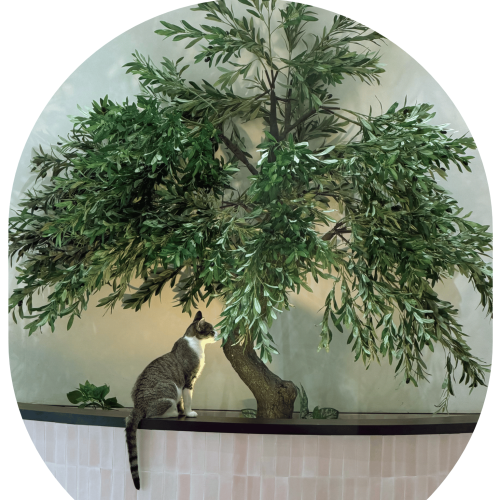
Nine Lives Mondays
Private Monday mediation at Nine Lives Café in West Palm Beach
Why Matthew Dietz created Nine Lives Mondays
Matthew Dietz’s disability rights work has long centered on a practical question. What would make it possible for someone to participate fully? His pioneering work on service animal access and emotional support animal accommodations showed him how much difference an animal can make in someone’s daily life.
As chair of The Florida Bar’s Animal Law Section, Dietz founded the Puppy Pit at the Florida Bar’s annual convention. He watched lawyers and judges arrive in the middle of a busy day, pick up a puppy, and visibly relax. They smiled, started talking, and became more approachable. Sometimes it lasted only a few minutes, but the change in how people related to one another was hard to miss.
For many litigants, mediation is one of the most stressful parts of a case. They may be hearing the other side’s account directly for the first time, weighing an offer with serious consequences, or trying to explain something deeply personal. When someone is bracing for what comes next, it can be hard to listen closely enough to understand the other person’s point of view or give an unfamiliar proposal a fair hearing.
Dietz created Nine Lives Mondays to bring what he learned into his mediation practice. At Nine Lives Café, a participant can take a few minutes to pet a cat that approaches, watch a kitten play, or share a light moment before returning to the discussion. The aim is to give people room to collect themselves, hear what the other side is saying, and weigh their options at their own pace.
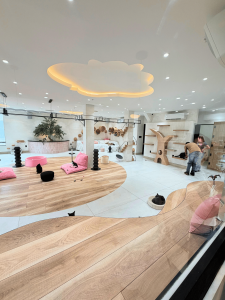
The Therapeutic Benefits of Spending Time With Cats
Participants who enjoy cats can take a breather in Cat Heaven between difficult conversations. Grounded in the principles of therapeutic justice, this intentional pause uses human-animal interaction to soften the adversarial edges of dispute resolution, helping to reduce the psychological stress and physiological tension often caused by traditional litigation. Participants are welcome to pet an approaching cat, watch the kittens play, or simply sit nearby in a calm, non-judgmental space designed to support emotional well-being and active engagement. Interaction is entirely optional.
Ease tension and stay engaged
A purring cat, gentle petting, or a kitten playfully chasing a toy can give participants something calm and comforting to focus on right after a difficult exchange. When high-stakes negotiations trigger heavy stress, interacting with animals provides an immediate emotional circuit breaker. This simple pause helps lower stress hormones, quiets sudden adrenaline spikes, and offers participants a natural moment to collect their thoughts or speak quietly with their attorney.
Stepping away from adversarial posturing even briefly allows everyone to return to the conversation with a clearer, more grounded, and far more receptive mindset. Beyond just taking a breather, this physical interaction redirects anxious nervous system energy into a soothing, tactile experience. Instead of ruminating on a contentious statement or nursing escalating frustration during a break, participants can channel their focus outward onto a gentle, neutral stimulus. The steady rhythm of stroking a soft coat or watching an unbothered animal explore its environment helps restore emotional equilibrium in real time. This reset ensures that when participants re-engage at the table, they do so with a lowered physiological arousal state, making it vastly easier to remain actively present, attentive, and constructively engaged in the mediation process rather than defensive or reactive.
Find an easy point of connection
A cat stretching across the table or a kitten batting at a toy can give people a moment to smile together. If both sides enjoy cats, they may find themselves swapping stories about pets or simply watching the same small scene unfold. That brief interaction gives people a chance to relate to each other outside the dispute, bridging the emotional divide before serious negotiations resume.
Discovering a shared appreciation for animals introduces a surprising element of shared humanity into an otherwise rigid and adversarial room. When opposing parties or counsel share a lighthearted chuckle or nod in agreement over an amusing feline antic, the psychological ice begins to thaw. It subtly shifts the atmosphere from a zero-sum battleground to a shared space populated by living, breathing creatures that care nothing about legal briefs or liability. This spontaneous moment of rapport helps de-escalate hostility, humanizing the individuals sitting across the table and establishing a subtle psychological bridge. By finding common ground over something as simple and universally endearing as a playful cat, participants often discover it is much easier to resume talking, explore compromises, and approach the negotiating table with a collaborative spirit rather than entrenched hostility.
Come back ready to listen
After a difficult exchange, participants may still be processing what just happened when the opposing party speaks again. Taking a quiet pause with the cats gives individuals the mental space to step back from their own immediate reactions and consider what they actually want to understand better. When the conversation resumes, participants are often better equipped to ask clarifying questions or check whether they accurately grasped the other side’s underlying concern.
Rather than planning their next rebuttal while the other person is talking, a structured feline break encourages genuine receptivity. Participants can focus on grasping what truly matters to the opposing party while still firmly disagreeing with their legal position. This subtle shift from defensive posturing to active comprehension transforms the dynamic of the room. By releasing some of the cognitive load tied up in anxiety and frustration, participants free up mental bandwidth to absorb nuances they might have otherwise missed. They return to the discussion with a patient, reflective mindset that fosters productive dialogue, helps uncover hidden areas of compromise, and paves the way for durable, mutually acceptable resolutions that might never have surfaced under high-pressure conditions.
How Cat Heaven Mediation Works
Cat Heaven and the separate café are reserved for the mediation and closed to the public during the session. Coffee and café treats are available throughout.
-
The mediation begins in Cat Heaven
Everyone gathers in the play area for the opening session. Cats and kittens roam the room and may wander across a table or along the overhead catwalks. Participants can interact with cats that approach or simply enjoy having them nearby.
The mediator explains the process and invite each side to make an opening statement. Parties and their attorneys can explain what happened from their perspective, what matters to them, and what they hope to accomplish. The parties then begin exploring options together. If the joint discussion is productive and everyone is comfortable continuing, the entire mediation can take place in Cat Heaven.
-
Each side takes a turn meeting privately in the café
In most mediations, the mediator meets separately with each side for a private conversation called a caucus. Participants can speak candidly, ask questions, and discuss what would make a proposal workable. The mediator confirms what each side wants shared before relaying an offer or other information.
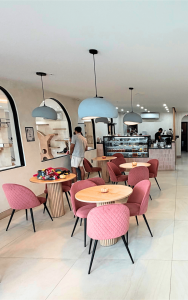
The mediator stays in the cat-free café, and each side comes in turn. While one side meets with the mediator, the other can spend time in Cat Heaven. Participants who need to speak confidentially with their attorney can ask the mediator to arrange a private space.
. -
The parties come back together in Cat Heaven
Both sides return to the play area to close the mediation. If the parties reach an agreement, the mediator reviews the terms with them and discusses putting them in writing. If issues remain open, the mediator helps clarify them and discusses next steps. The parties decide whether to settle and on what terms.
About Nine Lives Café and the Cats of Cat Heaven
Nine Lives Café began with Beaux, the first cat its founders, Raz and Jada, rescued. He inspired them to create a place where rescue cats could play, get comfortable around people, and meet their future families. The café works with local rescue partners, including Furry Friends Jupiter and Palm Beach County Animal Care and Control. Furry Friends also provides veterinary care.
Every cat in Cat Heaven is available for adoption. Participants who take a liking to a particular cat can ask the café team how to apply. Someone who comes to settle a case might also meet a future family pet.

Monday Booking and Fees
Mondays by reservation · $1,200 private venue rental
The $1,200 facility rental fee reserves both Cat Heaven and the café. The venue fee is the same for either a half or full day session length and is separate from the mediator’s fee. The $1,200 venue rental fee goes to Nine Lives Cafe Corp, the nonprofit that works to reduce shelter euthanasia by helping more cats find permanent homes.
Location and Directions
Nine Lives Café
2032 N Dixie Highway
West Palm Beach, FL 33407
Get Directions to Nine Lives Café
Bibliography
Nine Lives Café. About Us, Frequently Asked Questions, and Partners & Sponsorships.
Furry Friends Jupiter. Shelter, adoption, and veterinary services.
Palm Beach County Animal Care and Control. County shelter and adoption information.
Brooks, A. W., & Schweitzer, M. E. (2011). Can Nervous Nelly negotiate? How anxiety causes negotiators to make low first offers, exit early, and earn less profit. Organizational Behavior and Human Decision Processes, 115(1), 43–54.
Itzchakov, G., Weinstein, N., Leary, M., Saluk, D., & Amar, M. (2024). Listening to understand: The role of high-quality listening on speakers’ attitude depolarization during disagreements. Journal of Personality and Social Psychology, 126(2), 213–239.
Morris, M., Nadler, J., Kurtzberg, T., & Thompson, L. (2002). Schmooze or lose: Social friction and lubrication in e-mail negotiations. Group Dynamics: Theory, Research, and Practice, 6(1), 89–100.
Nagasawa, T., Kimura, Y., Masuda, K., & Uchiyama, H. (2023). Effects of interactions with cats in domestic environment on the psychological and physiological state of their owners: Associations among cortisol, oxytocin, heart rate variability, and emotions. Animals, 13(13), 2116.
Pendry, P., & Vandagriff, J. L. (2019). Animal visitation program (AVP) reduces cortisol levels of university students: A randomized controlled trial. AERA Open, 5(2).