










Flexible Fee Disability Law Services
Whether you have a disability or not, most people do not want to be involved in litigation. Disability law is one of the most detailed and complicated areas of civil rights law in the United States. These laws are intended to ensure that people with disabilities can take part in society equally, without discrimination or unnecessary barriers. Because disability law is so complex, it can be difficult to find clear guidance that applies to your specific situation.
Handling a disability-related matter can be difficult for both you and the organization responsible for providing access or accommodations. You may be unsure which accommodations to request, what medical information to provide, or how to explain why the accommodation is needed. Employers, businesses, medical providers, housing providers, schools, and courts may also have difficulty understanding their legal duties and deciding how an accommodation can be provided. These issues can lead to confusion, delays, and avoidable disputes.
Flexible Fee Services Offered
Our services are meant to give you the best chance of receiving an accommodation or being treated equally. We can help you provide the right medical information, explain why you need a specific accommodation, and show the legal reasons why it should be provided.
After you ask for an accommodation, there may be further discussions with the organization. This is often called the “interactive process.” We can help you respond to questions, provide additional information, and address concerns about your request. If your accommodation is denied, we will explain the steps you may take, the possible costs, and the risks of moving forward.
Flexible Fee Options
You may hire Dislaw Consulting under a flat-fee or hourly-fee agreement. The best choice will depend on the work you need, how clearly the work can be defined, and whether your situation is likely to change.
The process begins with an initial consultation. After the consultation, we will explain whether your matter is better suited for a flat fee, hourly billing, or a combination of both.
The Initial Consultation: Strategic Assessment
The process begins with a paid initial consultation, billed at $400 for up to one hour.
During the consultation, we will identify the laws that may apply, review the strengths and weaknesses of your matter, and discuss possible next steps. Before the meeting, you should provide any important policies, letters, emails, decisions, medical records, or other written materials that may help us understand your situation. Receiving these materials in advance allows us to make better use of the consultation.
Following the initial consultation, you can decide how best to proceed. Depending on your goals and the nature of your matter, you may choose to hire us under a flat-fee or hourly agreement, handle the matter on your own, or hire us only for certain defined services.
If you choose to continue representation with us, the $400 initial consultation fee will be credited toward your agreed-upon flat fee or initial billing deposit.
Flat-Fee Arrangements
Hiring a lawyer can feel uncertain, especially when you do not know how much the work will cost. A flat-fee agreement reduces that uncertainty by identifying the services and total fee before the work begins.
Under a flat-fee agreement, you hire us to complete specific legal work for a fixed price. This gives you access to experienced legal assistance without requiring you to begin a lawsuit or agree to open-ended legal fees.
For many disability-related issues, such as accommodation requests, compliance questions, or early-stage disputes, this model is often efficient and effective.
Flat-fee engagements begin at $2,500 for standard matters. Your exact fee will be determined before work begins. The flat fee will be based on the estimated time required to provide the requested services, including the difficulty and urgency of your matter, the complexity of the issues, and the type of legal work needed.
A flat-fee engagement will be tailored to handle a specific task or a combination of services. For example, it can cover reviewing medical, employment, housing, education, or other important records; drafting an accommodation or modification request; preparing a supporting legal letter; helping you take part in the interactive process; negotiating with employers or landlords; responding to a denial or a request for more information; or providing a written review of your rights and legal options.
The engagement agreement will identify the work included in the flat fee. Work outside that scope will require a separate agreement, an additional flat fee, or your authorization to proceed on an hourly basis.
A flat fee may be a good choice when the work can be clearly identified in advance and you want to know the cost before the work begins. However, some matters change over time or require work that cannot be predicted. In those situations, hourly billing may offer greater flexibility.
Hourly Legal Services
You may also hire Dislaw Consulting for legal services at an hourly rate of $750 per hour. Under this arrangement, you are billed for the actual time spent working on your matter, including reviewing documents, conducting legal research, preparing letters and other documents, communicating with you or another party, attending meetings, negotiating, and performing other legal work that you authorize.
Hourly billing may be appropriate when the amount of work cannot be known in advance, your situation is changing, or you need continuing legal help. You pay only for the time spent working on your matter, but the total cost may be less predictable than a flat fee. This is often the issue in any litigation that may be required.
The engagement agreement will explain billing increments, any required advance deposit, and the scope of the representation. It will also explain which services you have authorized and how you will receive billing statements.
Comparing Flat Fees and Hourly Fees
Flexible Options to Meet Your Needs
Whether you choose a flat fee, hourly billing, or a combination of both, our fee options are designed to provide flexibility, clear information, and control.
A flat fee offers a known cost for clearly defined services, while hourly billing allows our work to adapt as your needs develop. In some matters, a flat fee may be used for the first stage, followed by hourly billing if additional or unexpected work becomes necessary.
After the initial consultation, we will explain the available options, help you understand the expected costs and services, and work with you to select the arrangement that best fits your matter, priorities, and budget.
We will not perform any legal services beyond the initial consultation until you and Dislaw Consulting have signed a written engagement agreement describing the scope of work and applicable fees. The agreement will state what we have agreed to do, what is not included, and how you will be charged.
If you are interested, please fill out the contact form.
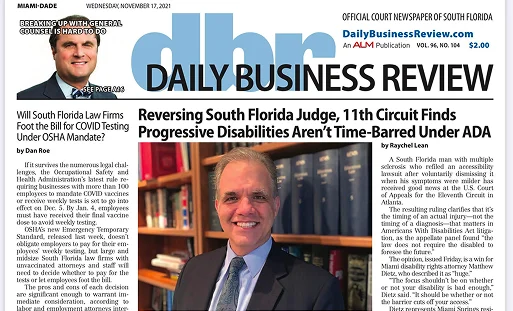
 Matthew Dietz is a civil rights attorney, disability law expert, and former Professor of Law whose career has been defined by advancing access, accountability, and systemic change for individuals with disabilities.