
The Federal Government May Be Abandoning Children with Disabilities in Florida and Terminating TPS Just Made the Situation More Dire.
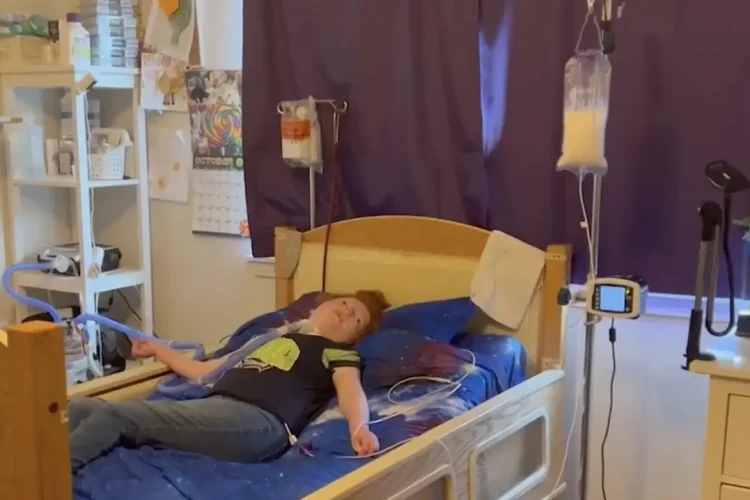
A medically fragile child who requires round-the-clock care. Photograph published by Florida Bulldog.
A recent Florida Bulldog investigation examines a dramatic change in the position of the United States Department of Justice—one that threatens decades of progress toward allowing people with disabilities to live in their homes and communities rather than being unnecessarily confined in institutions.
The article, written by Dan Christensen, focuses on a Notice from the Justice Department’s Office of Legal Counsel. The memorandum challenges the legal foundation of the disability-rights principle known as the integration mandate. That mandate requires public programs to provide services to people with disabilities in the most integrated setting appropriate to their needs.
The Office of Legal Counsel memorandum represents an extraordinary reversal from protecting people with disabilities against unnecessary institutionalization to supplying states with arguments for limiting those protections. The memorandum does not repeal the Americans with Disabilities Act, and the United States Supreme Court has not overturned its landmark decision in Olmstead v. L.C. Nevertheless, the Department’s new interpretation could give states a powerful argument for limiting home- and community-based services and continuing to rely on institutional care.
The Immediate Test Is Florida
The consequences of this reversal may first be felt in the long-running federal case concerning Florida children with medically complex disabilities who were unnecessarily placed in nursing homes instead of receiving the services needed to live with their families.
The Department of Justice sued Florida after an extensive investigation found systemic violations of the ADA. In 2023, following a two-week trial, a federal judge ruled against Florida and entered an injunction requiring reforms to the state’s Medicaid system and its delivery of private-duty nursing services.
Florida then appealed. On March 31, 2026, a divided panel of the United States Court of Appeals for the Eleventh Circuit upheld the federal government’s authority to bring the case and affirmed the central principle that unjustified institutionalization is a form of disability discrimination.
Florida is now asking the entire Eleventh Circuit to reconsider that decision. Within days after the Office of Legal Counsel issued its memorandum, Justice Department lawyers requested additional time to evaluate whether the federal government should change its position.
That sequence raises a deeply troubling possibility: the federal government may align itself with the State of Florida and help undermine the very judgment it spent more than a decade obtaining.
My Involvement in the Case
I was involved in the litigation on behalf of children with medically complex disabilities before the United States entered the case. My work in this area has included representing children and adults who were institutionalized, placed at risk of institutionalization, or denied the community-based services they needed to live safely with their families. Over more than 25 years of disability-rights practice, I have visited nursing homes and other facilities where children remained year after year. Many had parents who wanted them home and were willing to care for them. The obstacle was not a lack of family commitment. It was the state’s failure to provide sufficient nursing care, Medicaid services, equipment, training and other supports in the community.
A Court Without a Genuine Adversary
In speaking with Florida Bulldog, I explained that the developing situation resembles other cases in which nominally opposing government parties seek a judicial ruling that both sides actually want.
If Florida asks the Eleventh Circuit to eliminate or weaken the decision against it, and the Department of Justice agrees, there may no longer be a genuine adversary defending the judgment. The federal government would be asking the court to undo protections that the same government previously proved were necessary.
This is particularly dangerous because the children affected by the case are not the government officials making these decisions. They cannot independently appear before the court and defend the judgment that protects their ability to live at home.
As I explained in the article, there is no one presently standing before the court and forcefully arguing that the federal government and Florida cannot jointly dismantle these protections.
Florida’s Claimed Progress Has Not Been Independently Verified and Has Now Worsened Dramatically.
Florida and others have pointed to improvements made during the litigation. Some improvements may have occurred, but that does not establish that Florida has corrected the systemic violations identified by the federal court.
There is no independent monitor presently verifying the state’s representations. Children remain in nursing facilities, and there are continuing concerns that medically necessary nursing hours and other community services are not consistently available.
In fact, current immigration policy further belies the truth of this contention. The federal government has terminated Temporary Protected Status for Haiti, potentially affecting more than 300,000 Haitian TPS holders. Approximately one-third of the total 200,000 active Haitian TPS workers serving in healthcare-related roles. KFF cautions that the loss of lawful immigration status and employment authorization for Haitian workers, together with other restrictions on immigration, could further strain an already understaffed direct-care system. According to the Miami Herald, Florida alone has an estimated 35,000 Haitian healthcare workers
according to the Florida Health Care Association (FHCA). Major local employers, such as the Jackson Health System, Broward Health, and Memorial, have reported dozens of staff members facing sudden work authorization terminations. Ending the injunction based primarily on Florida’s assurances would remove oversight before there is reliable evidence that the changes are complete, durable and sufficient to protect children throughout the state.
The Threat Extends Far Beyond This Case
The Justice Department memorandum is not limited to medically fragile children. Its reasoning could affect people with intellectual and developmental disabilities, physical disabilities, mental-health disabilities and older adults who need publicly funded services to remain in their homes and communities.
If unnecessary institutionalization is no longer treated as discrimination, states could have greater freedom to reduce community programs, restrict in-home care and rely on nursing homes or other segregated facilities even when community living is appropriate and desired.
Most Americans do not remember the horrors of institutionalization, nor were they alive when Robert F. Kennedy famously described institutions for those with developmental or mental disabilities as “snake pits,” or when Geraldo Rivera’s groundbreaking investigation of Willowbrook first exposed the dehumanizing conditions within such facilities. The question of “what will happen to my child after I am no longer around” leaves many families facing the agonizing question of where their children will reside. Without the protection of the integration mandate, these individuals risk being relegated to facilities marked by neglect, isolation, boredom, and abuse rather than being supported in the community. If anyone needs a reminder – please see this films on the benefits of institutionalization from the 1950s.
The information provided on this website, including articles, videos, blog posts, and other resources, is provided solely for general educational and informational purposes. It is not legal advice and should not be relied upon as a substitute for advice from a qualified attorney regarding your specific circumstances. Laws change frequently, and the application of the law varies depending on the jurisdiction and on the facts of each case.